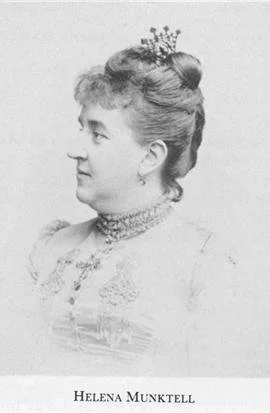
Helena Munktell
Swedish Composer
Born: 1852 (Grycksbo, Sweden)
Died: 1919 (Stockholm, Sweden)
BIOGRAPHY
Born into a musical family, Helena Munktell received her early musical education at Ivar Hallström’s Music Institute in Stockholm, Sweden. In 1870, she traveled to Paris with her mother to pursue studies in voice. Her musical interests soon expanded to piano performance and composition, leading her to study instrumentation with Benjamin Godard, a student of the violinist Henri Vieuxtemps.
Throughout her compositional career, Munktell worked across a diverse range of genres, including art songs, opera, orchestral music, choral works, and chamber music. Her musical language was shaped by both the French musical tradition and the folk melodies of her Swedish heritage, resulting in a distinctive synthesis of French and Nordic influences.
Munktell established a significant reputation as a composer and performer, gaining considerable recognition following her debut concert in 1885. Several years later, she was elected as a member of the French Composers Association, further affirming her position within the French musical community. During this period, Munktell also encountered the French composer Vincent d’Indy, a former student of César Franck. D’Indy became an important mentor and advocate for Munktell, supporting her development as a composer and promoting her music.
Munktell’s compositional style reflects the intersection of her Swedish cultural heritage and her extensive exposure to French musical traditions. The combination of French approaches to musical form and sonority with Nordic folk influences contributed to the individuality of her musical language. Her work demonstrates how these distinct traditions could be integrated into a cohesive and personal compositional style.
Sonata for Piano and Violin (1905)
SONATA INFORMATION
Munktell’s violin sonata was premiered by George Enescu and Auguste Pierret in 1905. The premiere was given high reviews, and soon the sonata was also performed and well-received in Berlin.⁶ This piece quotes Swedish melodies and rhythms.
Her sonata has been described as, “rich in surprising turns and adhering closely to the main key but with a variety of harmony achieved by innumerable suspensions, passing notes and other adornments in the French style.”⁷
I. Allegro non tanto, vigoroso (~8 min)
II. Scherzo brusco: Moderato energico (~6 min)
III. Andante quasi adagio (~8 min)
IV. Finale. Allegro con brio - Più lento (~8 min)
SCORES
1. Manuscript Location: Musik- och teaterbiblioteket
2. First Edition: IMSLP, Koha, Performer’s Edition, Amazon
RECORDINGS
Tobias Ringborg and Peter Friis Johansson: Spotify, YouTube, Naxos
Sources
Wiberg, Karin. “Helena Mathilda Munktell.” Swedish Women’s Biographical Lexicon, 2018. https://skbl.se/sv/artikel/HelenaMunktell.
Jacobsson, Stig. “Munktell, Helena.” Gerhmans Musikforlag, https://www.gehrmans.se/en/composers/munktell-helena.
Wiberg, “Helena Mathilda Munktell.”
Öhrström, Eva. "Munktell, Helena." Grove Music Online. 2001. https://www-oxfordmusiconline-com.ezproxy1.lib.asu.edu/grovemusic/view/10.1093/gmo/9781561592630.001.0001/omo-9781561592630-e-0000045505.
Wiberg, “Helena Mathilda Munktell.”
Jacobsson, “Munktell, Helena.”
Ibid.