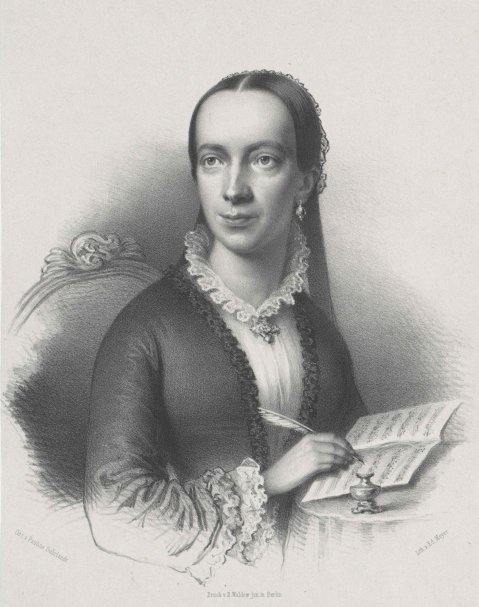
Emilie Mayer
German Composer
Born: 1812 (Friedland, Mecklenburg-Vorpommern)
Died: 1883 (Berlin)
BIOGRAPHY
Born in 1812, Emilie Louise Friderica Mayer displayed musical promise from an early age, receiving informal instruction as a child. However, she did not begin serious musical study until the age of twenty-eight, a remarkably late start for a composer who would later become one of the most accomplished women of the Romantic era. Despite this unconventional beginning, Mayer's exceptional talent quickly attracted the attention of prominent German musicians, including the esteemed city music director Carl Loewe.
After relocating to Berlin in 1847, Mayer studied composition, music theory, and orchestration with Adolf Bernhard Marx and Wilhelm Wieprecht, both influential figures in nineteenth-century German musical life and contemporaries of Felix Mendelssohn. Under Marx's guidance, her compositional voice evolved beyond the Classical Viennese tradition toward the richer harmonic language of Romanticism. Her later works feature more adventurous modulations, expanded chromatic harmony, frequent use of seventh chords, and increasingly sophisticated rhythmic writing. Scholars have also noted stylistic similarities to Mendelssohn, particularly in her lyrical melodies, transparent textures, and refined orchestration.
Mayer's rapid artistic growth soon brought public recognition. Just three years after beginning her studies with Marx, she presented an entire concert of her own compositions to enthusiastic audiences and critical acclaim. Around this same period, she was awarded the Gold Medal for Art by Queen Elisabeth of Prussia in recognition of her outstanding contributions to German musical culture.
Although Mayer did not achieve widespread fame until later in her career, she is now regarded by many scholars as "the most prolific German woman composer of the Romantic period." Her remarkable catalog includes eight symphonies, concert overtures, lieder, choral works, chamber music, piano pieces, and numerous other compositions. During her lifetime, her music was performed throughout Germany and across Europe, earning admiration from audiences and critics alike.
Despite her success during the nineteenth century, Mayer's music largely disappeared from the concert repertoire following her death in 1883. In recent decades, however, renewed scholarly interest has sparked a revival of her works, leading to new performances, recordings, and publications. Many of her manuscripts are preserved in the Berlin State Library (Staatsbibliothek zu Berlin), where they continue to serve as an invaluable resource for performers and researchers interested in rediscovering her significant musical legacy.
Emilie Mayer composed nine sonatas for violin and piano, seven of which are currently available. Although the exact dates of composition are unknown, most scholars believe these sonatas were written between 1863 and 1869, when Mayer was in her fifties and at the height of her compositional maturity.
This website features the six violin sonatas that most clearly reflect Mayer's mature Romantic style. The Sonata in E-flat Major, which exhibits a more Classical character, is not included in this collection but will be added to the website at a later date.
Sonata in D Major for Violin and Piano (~1863)
SONATA INFORMATION
The movements of this Sonata in D Major include the following:
I. Agitato con passione (~8 min)
II. Adagio (~6 min)
III. Scherzo (~3 min)
IV. Finale- Allegro (~6 min)
Sonata in C Minor for Violin and Piano (~1863)
SONATA INFORMATION
I. Andante - Allegro vivace (~7 min)
II. Scherzo (~6 min)
III. Adagio ma non troppo (~5 min)
IV. Allegro con spirito (~6 min)
Sonata for Piano and Violin in F Major, Op. 17 (~1863)
SONATA INFORMATION
This sonata was dedicated to Mayer’s nephew, Ewald Bertuch.
I. Andante - Allegro con troppo cantabile (~8 min)
II. Adagio non troppo (~5 min)
III. Scherzo, Allegro molto (~5 min)
IV. Allegro (~4 min)
Sonata in A Minor for Piano and Violin, Op. 18 (~1864)
SONATA INFORMATION
This piece was dedicated to Professor Leopold von Ranke, Mayer’s colleague and friend.
”Surely this qualifies as a masterpiece. It need fear comparison from any other contemporary sonata and undoubtedly belongs in the front rank of violin sonatas.” -Edition Silvertrust
I. Allegro con brio (~7 min)
II. Adagio - Allegro agitato (~6 min)
III. Adagio - Andante (~6 min)
IV. Allegro con brio (~6 min)
SCORES
1. Manuscript location: Unknown
2. First Edition: IMSLP
3. Second Edition: Hildegard and SheetMusicPlus
4. Third Edition: Edition Silvertrust
RECORDINGS
Aleksandra Maslovaric and Anne-Lise Longuemare: Youtube and Amazon
Sonata in E Minor for Piano and Violin, Op. 19 (~1867)
SONATA INFORMATION
This sonata was dedicated to German conductor and composer W. Wieprecht.
I. Allegro agitato (~12 min)
II. Scherzo (~5 min)
III. Adagio (~7 min)
IV. Allegro con brio (~6 min)
Sonata in D Minor for Piano and Violin, Op. 29 (~1869)
SONATA INFORMATION
This piece was dedicated to Duchess Caroline Mariane of Mecklenburg-Strelitz (later to become the Princess of Denmark.)
I. Allegro (~7 min)
II. Adagio, molto espressione, man non troppo lento (~4 min)
III. Scherzo (~6 min)
IV. Allegro moderato (~5 min)
Sources
Conway, David Allen. Jewry in Music: Entry to the Profession from the Enlightenment to Richard Wagner. Cambridge University Press, 2016.
Haag, John. "Mayer, Emilie (1821–1883)" Women in World History: A Biographical Encyclopedia. Encyclopedia.com. https://www.encyclopedia.com/women/encyclopedias-almanacs-transcripts-and-maps/mayer-emilie-1821-1883.
Rieger, Eva. “Mayer, Emilie.” Oxford Music Online, 2001. https://doi.org/10.1093/gmo/9781561592630.article.47439.