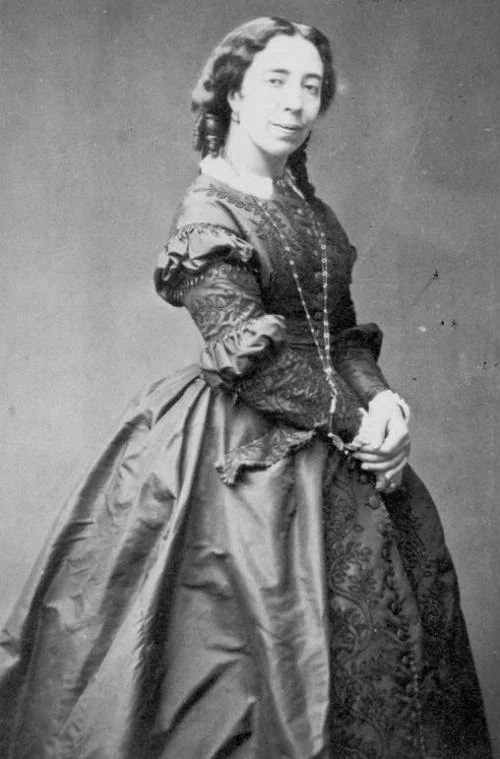
Pauline Viardot
French Mezzo-Soprano and Composer
Born: 1821 (Paris, France)
Died: 1910 (Paris, France)
BIOGRAPHY
Pauline Viardot (born Michelle Ferdinande Pauline García) was one of the most celebrated singers, composers, and musical figures of the nineteenth century. Raised in Paris, she grew up in a highly musical household. Her father, Manuel García, was a renowned tenor, composer, and vocal pedagogue who provided her early musical training. Following his death in 1832, Viardot continued her studies by taking piano lessons with Franz Liszt, further developing the musicianship that would shape her remarkable career. Although she initially considered a career as a pianist, she soon turned her focus toward opera. At the age of sixteen, she made her vocal debut, accompanied by her brother-in-law, the violinist Charles de Bériot.
Viardot quickly gained recognition as one of the most accomplished performers of her generation. She was admired not only by audiences but also by many of the leading composers and musicians of her time, including Clara and Robert Schumann, Frédéric Chopin, Richard Wagner, and Johannes Brahms. Her Parisian home became an important center of musical life, where artists gathered for intimate concerts, discussions, and performances of new works. Hector Berlioz praised Viardot’s exceptional artistry, describing her talent as remarkably complete and versatile, capable of combining technical mastery with profound emotional expression.
In 1840, Viardot married Louis Viardot, an influential writer, theater director, and art critic. At a time when married women were often discouraged from pursuing professional careers, Viardot maintained an active and successful life as a performer and musician. Throughout her career, she appeared at many of Europe’s most prestigious opera houses and spent four seasons performing with the Imperial Opera in Saint Petersburg, where she sang in multiple languages and expanded her international reputation.
Beyond her achievements as a performer, Viardot played a significant role in supporting and promoting the next generation of composers. Through the musical gatherings held in her home, she championed the early careers of composers including Camille Saint-Saëns, Charles Gounod, Jules Massenet, and Gabriel Fauré. Many of these composers dedicated works to her, recognizing both her artistic influence and her contributions to the musical community.
Viardot was also a prolific composer in her own right. Her compositional output includes numerous mélodies, vocal works, chamber music, and short piano pieces. She also created transcriptions of Chopin’s mazurkas and arrangements of works by composers such as Schubert, Brahms, and Haydn. Her compositions reflect her deep understanding of the voice, her exceptional musical training, and her lifelong engagement with the broader European musical tradition.
After retiring from the stage, Viardot and her family settled in Baden-Baden, where she continued to teach, compose, and mentor young musicians. Several of her students went on to successful singing careers, including Désirée Artôt, Aglaja Orgeni, Marianne Brandt, and Antoinette Sterling. Her influence extended within her own family as well, as two of her children later pursued careers as composers and performers. Through her artistry, teaching, and advocacy, Viardot left a lasting impact on nineteenth-century musical culture.
Sonatina for Piano and Violin (1873)
SONATINA INFORMATION
Pauline Viardot wrote one sonatina for violin and piano. Dedicated to Hubert Leanord, Viardot’s son’s violin teacher, this piece was influenced by operatic idioms. It also has hints of Spanish influence, reflective of the composer’s Spanish roots.
Viardot was 52 years old when she composed her Violin Sonatina in A minor. The work includes three movements:
I. Adagio (~ 5 min)
II. Allegro (~2 min)
III. Allegro Finale (~4 min)
“Pauline Viardot’s compositions are now gaining deserved recognition. Her gracefully probing Violin Sonatina should really be a repertoire piece.” - Music Magazine, 2017
SCORES
1. Original Manuscript: No longer available
2. First Edition (1873): IMSLP and BnF
3. Second Edition (1993): Hildegard, SheetMusicPlus, Presser, and Theodore Front Musical Literature
RECORDINGS
1. Reto Kuppel and Wolfgang Manz: PrestoMusic, YouTube, Naxos, and Spotify
2. Kate Arndt and Katherine Miller: YouTube
Sources
Borchard, Beatrix. “Viardot [Née García], (Michelle Ferdinande) Pauline.” Oxford Music Online, January 20, 2001. https://doi.org/10.1093/gmo/9781561592630.article.29283.
Plaut, Linda B. “Sonatina for Violin and Piano by Pauline Viardot-Garcia.” Hildegard Publishing Company, 1993. https://www.hildegard.com/catalog.php?keyword=494-02592.
FitzLyon, April. The Price of Genius: A Life of Pauline Viardot. London: Calder Publications, 2011.
“Pauline Viardot-García - a Modern Reveal: Songs and Stories of Women Composers.” A Modern Reveal, 2022. https://www.amodernreveal.com/pauline-viardotgarcia#:~:text=As%20a%20composer%2C%20Viardot%20was,Gautier%2C%20M%C3%B6rike%2C%20and%20Goethe.
Borchard, “Viardot [Née García], (Michelle Ferdinande) Pauline.”